Quick Answer
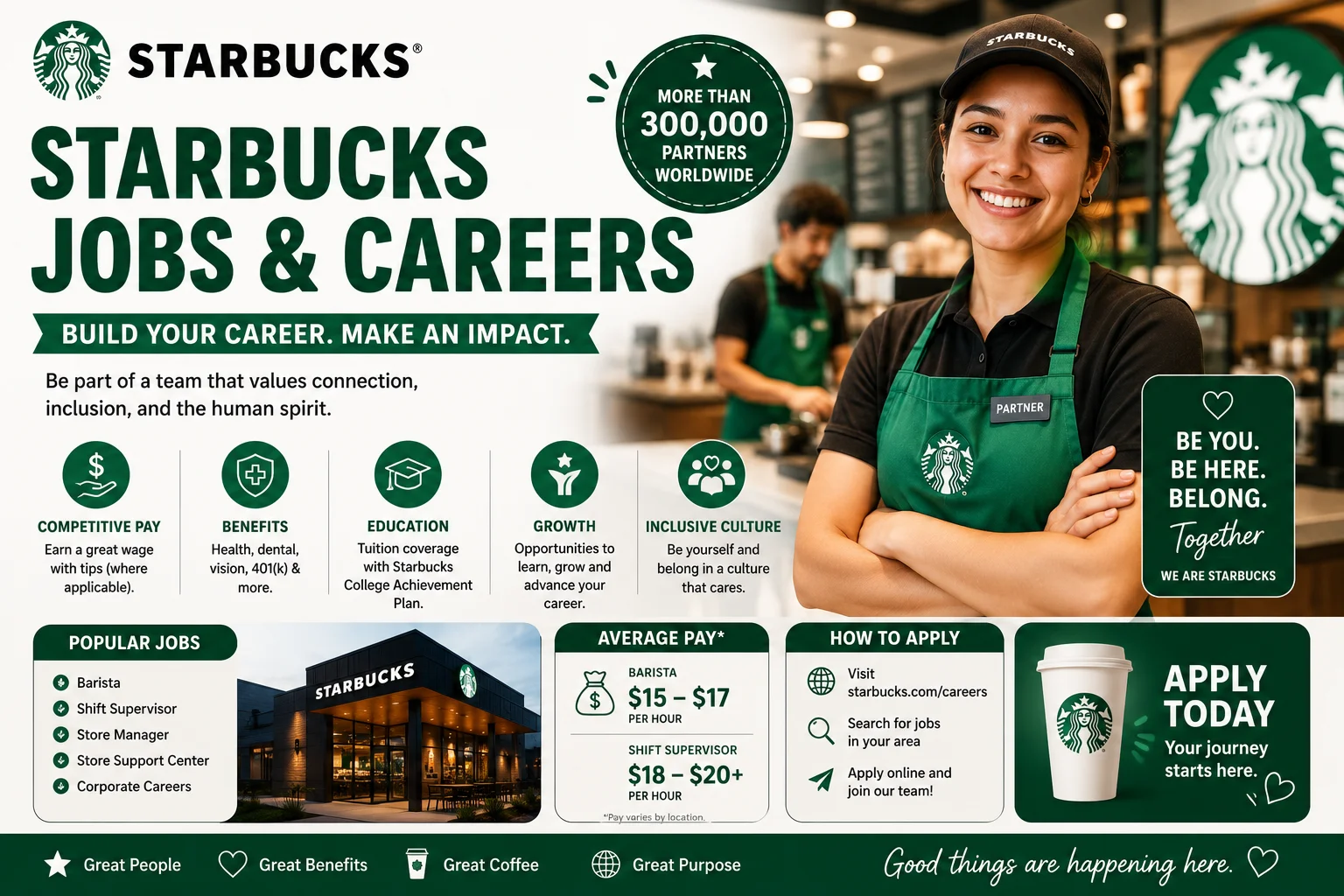
Starbucks jobs include barista, shift supervisor, store manager, corporate, and selected remote roles. Most people begin with a barista position, receive paid training, and can grow into leadership or corporate careers over time. Pay, benefits, hiring requirements, and available positions vary by country, store location, and business needs.
Starbucks Jobs
Finding the right Starbucks jobs can feel more challenging than simply submitting an application. Every store hires for different roles, schedules, and experience levels, while corporate and remote opportunities follow their own recruitment process. Choosing the wrong position often leads to unnecessary rejections or interviews that don’t match your skills.
Starbucks Careers
Join our mission to inspire and nurture the human spirit – one person, one cup, and one neighborhood at a time.
Types of Starbucks Jobs
One of the biggest advantages of working at Starbucks is the variety of career opportunities available. While many applicants start as baristas, Starbucks also hires for leadership, management, corporate, supply chain, technology, finance, marketing, design, and selected remote positions depending on business needs and region.

Choosing the right role before submitting your Starbucks job application online can improve your chances of getting hired because every position requires different skills, availability, and experience.
Starbucks Barista Jobs
Starbucks barista jobs are the most common entry point into the company. Baristas prepare beverages, greet customers, operate the register, maintain store cleanliness, restock supplies, and help create a welcoming coffeehouse environment.
Starbucks Barista Job Description
Typical daily responsibilities include:
- Preparing hot, iced, and blended beverages
- Greeting customers and taking accurate orders
- Operating the point-of-sale system
- Maintaining food safety and cleanliness standards
- Restocking ingredients and merchandise
- Working efficiently during busy hours
- Supporting teammates throughout each shift
Starbucks Barista Job Specification
Although requirements vary by location, successful applicants usually demonstrate:
- Strong communication skills
- Positive customer service attitude
- Reliability and punctuality
- Ability to work in a fast-paced environment
- Teamwork and adaptability
- Basic math and cash-handling skills
- Flexible availability, including weekends or holidays when required
Editorial Insight: New applicants often believe making coffee is the hardest part of the job. In reality, many partners say learning to manage customer flow during busy morning rushes becomes the biggest challenge. Drink preparation usually becomes much easier after completing store training.
Shift Supervisor Jobs
After gaining experience, many partners move into a shift supervisor role.
A shift supervisor not only prepares beverages but also helps lead the team during each shift. Responsibilities include assigning tasks, managing breaks, handling customer concerns, monitoring inventory, and ensuring daily operations run smoothly.
This role suits applicants who enjoy leadership while still working directly with customers.
Store Manager Careers
Store managers oversee the complete operation of a Starbucks location.
Their responsibilities typically include:
- Hiring and coaching employees
- Scheduling staff
- Monitoring sales performance
- Managing labor costs
- Supporting customer satisfaction
- Maintaining operational standards
- Developing future team leaders
Many successful store managers began their careers as entry-level baristas, making internal promotion one of Starbucks’ strongest career development pathways.
Starbucks Corporate Jobs
Not every Starbucks career takes place behind the coffee bar. Starbucks corporate jobs support retail stores through specialized departments such as:
- Finance
- Human Resources
- Marketing
- Technology
- Product Development
- Supply Chain
- Legal
- Design
- Real Estate
- Data Analytics
- Communications
These positions generally require professional experience or specialized education, though requirements vary by role.
Remote Starbucks Jobs
Some applicants specifically search for remote Starbucks jobs. While most store positions require in-person work, selected corporate departments occasionally offer hybrid or remote opportunities based on business needs and local policies.
Examples may include:
- Technology
- Software Engineering
- Customer Support
- Data Analysis
- Digital Product Management
- Marketing
- Administrative Support
Remote availability changes over time, so applicants should review current openings through Starbucks Careers before applying.
Starbucks Part-Time Jobs for Students
Many students choose Starbucks part-time jobs because scheduling can often accommodate school or university commitments, depending on store staffing needs.
A part-time role may help students gain experience in:
- Customer service
- Communication
- Team collaboration
- Time management
- Problem solving
- Leadership development
These transferable skills remain valuable even after moving into different industries later in a career.
Original Observation: Students who communicate their class schedule clearly during the hiring process often experience fewer scheduling conflicts after joining the team. Being transparent about availability from the beginning usually creates a smoother working relationship with store management.
Which Starbucks Job Fits You?
| Career Goal | Recommended Starbucks Role |
|---|---|
| First job with no experience | Barista |
| Flexible schedule while studying | Part-Time Barista |
| Leadership experience | Shift Supervisor |
| Retail management career | Assistant Store Manager / Store Manager |
| Office-based professional work | Corporate Jobs |
| Technology or business career | Corporate Technology & Business Roles |
| Hybrid or home-based opportunities | Selected Remote Corporate Positions |
This simple comparison helps applicants narrow their options before beginning a Starbucks job search, reducing the chances of applying for roles that don’t match their experience or career goals.
Starbucks Job Application
Submitting a Starbucks job application is straightforward, but getting invited for an interview depends on much more than completing an online form. Choosing the right position, matching your availability, presenting relevant skills, and applying to locations that are actively hiring can all improve your chances of moving to the next stage.
Many applicants focus only on finding Starbucks jobs near me or Starbucks jobs hiring near me, but a well-prepared application is often more important than applying to the largest number of openings.
Quick Answer: How to Get a Job at Starbucks
Most applicants can apply by creating an account on the Starbucks Careers website, selecting an available position, completing the online application, and waiting for the hiring team to review it. If shortlisted, candidates are usually contacted for an interview before receiving a hiring decision.
While previous coffee experience can be helpful, it is not required for many entry-level retail positions. Customer service skills, reliability, communication, and a positive attitude are often valued just as highly.

How to Apply for Starbucks Jobs
The Starbucks job application online process is designed to be simple, but taking a few extra minutes to complete it carefully can make a noticeable difference.
Step 1: Search Available Positions
Start by searching current openings based on your location, preferred schedule, and experience level.
Common searches include:
- Starbucks jobs hiring
- Starbucks job openings
- Starbucks job opportunities
- Starbucks barista jobs
- Starbucks corporate jobs
- Starbucks remote jobs
- Starbucks part-time jobs
Apply only for roles that genuinely match your availability and qualifications.
Step 2: Create Your Starbucks Careers Account
You’ll need a Starbucks Careers account before submitting applications.
Your profile typically allows you to:
- Save job searches
- Track applications
- Update your resume
- Receive hiring updates
- Manage future applications
Many applicants also search for Starbucks jobs login when returning to check their application status or apply for additional roles.
Step 3: Complete the Application Carefully
A strong application should accurately reflect your experience without exaggeration.
Pay close attention to:
- Contact information
- Employment history
- Education
- Availability
- Customer service experience
- Teamwork examples
- Language skills, if applicable
Small mistakes—such as incorrect phone numbers or incomplete availability—can delay the hiring process.
Step 4: Upload a Professional Resume
Even when a resume is optional, uploading one often helps present your experience more clearly.
Starbucks Resume Checklist
Include skills that match retail and customer-focused work whenever they genuinely apply to your experience.
✔ Customer service
✔ Teamwork
✔ Communication
✔ Cash handling
✔ Time management
✔ Problem solving
✔ Adaptability
✔ Fast-paced work environment
✔ Food service or hospitality experience
✔ Leadership or volunteer activities
Editorial Observation: Applicants sometimes underestimate volunteer work, school projects, or community activities. These experiences can demonstrate teamwork, responsibility, and communication—qualities that hiring managers often value for entry-level Starbucks roles.
Step 5: Submit Your Application
Before clicking submit, review everything one final time.
Ask yourself:
- Is every section complete?
- Is my availability accurate?
- Is my resume updated?
- Did I apply for the correct location?
- Does my experience match the position?
Taking two extra minutes to review your application can prevent simple errors that create a poor first impression.
What Happens After You Apply?
After submitting your Starbucks job application online, the hiring timeline varies by store, hiring demand, and local recruitment needs.
A typical process may include:
- Application review
- Initial screening
- Interview invitation
- One or more interviews
- Hiring decision
- Background checks or onboarding steps (where required)
- Training and first shift
Some applicants receive updates quickly, while others may wait longer depending on staffing priorities.
Starbucks Hiring Process
Although every location manages recruitment differently, most hiring follows a similar pattern.
| Stage | What to Expect |
|---|---|
| Application | Submit your online application and resume |
| Review | Hiring manager evaluates your qualifications |
| Interview | Questions about customer service, teamwork, and availability |
| Hiring Decision | Successful candidates receive an offer if selected |
| Onboarding | Complete required paperwork and orientation |
| Training | Learn store operations, recipes, safety, and customer service standards |
Original Insight: Many applicants assume hiring decisions depend mainly on previous coffee experience. In practice, retail managers often place greater importance on reliability, communication, willingness to learn, and schedule flexibility. Technical drink-making skills are usually taught during training.
Common Starbucks Job Application Mistakes
Avoiding these common mistakes can improve your chances of getting noticed.
- Applying without updating your resume
- Selecting incorrect work availability
- Applying for positions that don’t match your experience
- Ignoring follow-up emails
- Using an unprofessional email address
- Including spelling or grammar mistakes
- Applying to only one location when multiple nearby stores are hiring
Small improvements won’t guarantee an interview, but they can help your application appear more complete and professional.
Before You Submit Your Application
A strong Starbucks application is usually built on preparation rather than luck.
Before applying, make sure you can confidently answer these questions:
- Why do you want to work at Starbucks?
- Can you work flexible hours if required?
- Are you comfortable serving customers during busy periods?
- Can you work well in a team environment?
- What examples demonstrate your customer service skills?
Preparing these answers early also makes interview preparation much easier later in the hiring process.
Starbucks Interview Process
Receiving an interview invitation is the next major step after submitting your application. Most interviews focus less on coffee knowledge and more on how you communicate, solve problems, work with others, and handle customer situations.
For entry-level retail roles, interviewers usually want to understand whether you’ll contribute positively to the team and provide a welcoming customer experience.
Editorial Observation: Many successful applicants say they worried about memorizing coffee recipes before the interview. In reality, interviewers are often more interested in attitude, reliability, and customer service than technical drink-making knowledge.
Common Starbucks Interview Questions
While every interview is different, these questions appear frequently.
- Tell me about yourself.
- Why do you want to work at Starbucks?
- Why should we hire you?
- Describe a time you helped a customer.
- Tell me about a challenge you solved as part of a team.
- How would you handle an unhappy customer?
- How do you prioritize tasks during busy periods?
- What does good customer service mean to you?
- Are you available on weekends, mornings, or holidays?
- Where do you see yourself in the future?
Preparing thoughtful answers helps you sound more confident instead of trying to think under pressure.
STAR Interview Answer Examples
Many hiring managers appreciate clear, structured answers. The STAR method (Situation, Task, Action, Result) is a simple way to organize your response.
Example 1: Teamwork
Question: Tell me about a time you worked as part of a team.
Situation: Our class organized a fundraising event.
Task: I was responsible for coordinating volunteers.
Action: I created a schedule, assigned responsibilities, and kept everyone informed throughout the event.
Result: The event ran smoothly, volunteers stayed organized, and we exceeded our fundraising goal.
Example 2: Customer Service
Question: Describe a difficult customer situation.
Situation: A customer received the wrong order.
Task: I needed to resolve the issue quickly.
Action: I apologized, confirmed the correct order, and arranged a replacement while keeping the customer updated.
Result: The customer appreciated the quick response and left satisfied.
Even if your experience comes from school, volunteering, or another part-time job, structured answers like these demonstrate communication and problem-solving skills.
What Happens on Your First Day?
Starting a new job naturally feels overwhelming, but Starbucks provides training to help new partners become familiar with store routines.
During your first shifts, you may experience:
- Team introductions
- Store tour
- Safety procedures
- Food handling standards
- Register training
- Beverage preparation basics
- Customer service expectations
- Cleaning routines
- Daily opening or closing tasks
New employees are not expected to memorize every recipe immediately. Learning happens gradually through training and practical experience.

Editorial Insight: The first few shifts usually focus on understanding store routines rather than speed. Accuracy, teamwork, and asking questions when unsure often leave a better impression than trying to work too quickly.
A Day in the Life of a Starbucks Barista
No two shifts are exactly the same, but most retail stores follow a similar rhythm.
Before Opening
- Prepare equipment
- Restock ingredients
- Check inventory
- Organize workstations
- Prepare for the morning rush
Morning Rush
Morning hours are often the busiest because many customers stop for coffee before work or school.
Baristas may:
- Prepare multiple drinks simultaneously
- Process customer payments
- Warm food items
- Communicate with teammates
- Keep wait times as short as possible
Midday
Customer traffic usually becomes more balanced.
This time may include:
- Cleaning equipment
- Restocking supplies
- Rotating inventory
- Supporting new team members
- Preparing mobile orders
Closing Shift
Evening responsibilities often include:
- Deep cleaning
- Inventory checks
- Cash reconciliation (where assigned)
- Preparing the store for the next day
Skills That Help You Succeed at Starbucks
Technical skills can be taught, but several personal qualities consistently help employees perform well.
| Skill | Why It Matters |
|---|---|
| Communication | Builds positive customer relationships |
| Teamwork | Helps stores operate efficiently during busy periods |
| Time Management | Keeps service moving during rush hours |
| Adaptability | Supports changing priorities throughout the day |
| Attention to Detail | Improves drink accuracy and food safety |
| Positive Attitude | Creates a welcoming customer experience |
Many of these skills can come from school projects, volunteering, hospitality, retail, or other customer-facing roles.
Common Hiring Myths
Many applicants avoid applying because of common misconceptions.
Myth: You need coffee shop experience.
Reality: Many entry-level baristas are hired without previous coffee experience and receive training after joining.
Myth: Every Starbucks store pays exactly the same.
Reality: Pay varies depending on country, region, local laws, experience, and position.
Myth: Part-time employees cannot build long-term careers.
Reality: Many retail leaders began as part-time baristas before moving into supervisory or management positions.
Myth: The interview is mainly about coffee knowledge.
Reality: Customer service, communication, teamwork, and reliability are usually more important than memorizing beverage recipes.
Practical Tips Before Your Interview
Small details often make a positive impression.
- Arrive a few minutes early.
- Dress neatly and professionally.
- Bring an updated resume if requested.
- Maintain eye contact and speak clearly.
- Show enthusiasm for customer service and teamwork.
- Be honest about your availability.
- Prepare a few thoughtful questions for the interviewer.
Original Observation: Candidates who explain why they enjoy helping customers often leave a stronger impression than those who simply say they “need a job.” Genuine motivation is easier for interviewers to remember than rehearsed answers.
Starbucks Jobs Pay, Salary & Employee Benefits
One of the most common questions applicants ask is how much Starbucks jobs pay. The answer depends on several factors, including your role, location, local labor laws, experience, and whether you work part-time or full-time. Retail positions are generally paid hourly, while management and many corporate positions receive a salary.
Because pay structures differ by market, it’s more useful to compare roles than rely on a single hourly rate.
Pay Disclaimer: Compensation, bonuses, and benefits vary by country, state, city, and individual position. Always review the pay information listed in the official job posting before accepting an offer.
Starbucks Job Salary by Role
The table below shows how different positions are typically structured.
| Position | Typical Pay Structure | Experience Level |
|---|---|---|
| Barista | Hourly | Entry Level |
| Shift Supervisor | Hourly | Retail Experience |
| Assistant Store Manager | Salary / Hourly (market dependent) | Leadership Experience |
| Store Manager | Salary | Management Experience |
| Corporate Roles | Salary | Professional Experience |
| Remote Corporate Roles | Salary | Professional Experience |
Instead of asking, “Does Starbucks pay $15 an hour?” or “Do Starbucks employees make $20 an hour?”, it’s better to understand that hourly wages depend on local markets and applicable employment laws. Some locations may pay more than others because of cost of living, experience requirements, or company policies.
Starbucks Employee Benefits
Benefits vary by eligibility requirements, hours worked, employment status, and local regulations. Not every benefit is available in every market.
Common benefits may include:
- Competitive pay
- Paid training
- Employee discounts
- Health-related benefits (where eligible)
- Paid time off (where eligible)
- Retirement programs (where available)
- Stock or equity programs in eligible markets
- Education assistance in selected regions
- Career development programs
- Internal promotion opportunities
Benefits Comparison
| Benefit | Retail Positions* | Corporate Positions* |
|---|---|---|
| Paid Training | ✔ | ✔ |
| Employee Discount | ✔ | ✔ |
| Career Development | ✔ | ✔ |
| Health Benefits | Eligible Positions | Eligible Positions |
| Paid Leave | Based on Eligibility | Based on Eligibility |
| Retirement Programs | Market Dependent | Market Dependent |
*Eligibility requirements vary by market and employment status.
Starbucks Career Growth
Many people apply for a Starbucks job expecting temporary work, but the company also offers long-term career progression for employees who perform well.
A common career path looks like this:
Barista
↓
Shift Supervisor
↓
Assistant Store Manager
↓
Store Manager
↓
District Leadership or Corporate Opportunities
Internal promotions often depend on performance, leadership ability, business needs, and available positions.
Editorial Observation: One consistent pattern across many Starbucks career stories is that employees who actively learn beyond their assigned responsibilities often progress faster. Helping train teammates, volunteering for additional responsibilities, and maintaining strong customer service habits can support future promotion opportunities.
Which Starbucks Job Matches Your Personality?
Choosing a role that fits your strengths often leads to a better experience than applying only because a position is available.
| Your Strength | Recommended Role |
|---|---|
| Enjoy meeting new people | Barista |
| Like leading teams | Shift Supervisor |
| Interested in business operations | Store Manager |
| Analytical thinking | Finance or Data Roles |
| Creative work | Marketing or Design |
| Technology | IT or Engineering |
| Project Management | Corporate Support Roles |
Matching your personality with the right position can improve both job satisfaction and long-term career growth.
Who Should Consider Starbucks Part-Time Jobs?
Starbucks part-time jobs may be a good choice for:
- College and university students
- People looking for a second job
- Parents seeking flexible schedules
- Individuals returning to work
- Applicants building customer service experience
Part-time work can also help develop transferable skills that remain valuable across many industries.
Who May Prefer Another Type of Job?
A Starbucks retail position may not be the best fit if you:
- Prefer working alone most of the day.
- Dislike fast-paced environments.
- Want a traditional Monday-to-Friday office schedule.
- Prefer jobs without regular customer interaction.
- Cannot work flexible shifts when required.
Understanding the work environment before applying can help prevent disappointment later.
Quick Career Decision Guide
Still deciding which Starbucks job suits you?
| Goal | Best Option |
|---|---|
| First Job | Barista |
| Flexible Student Schedule | Part-Time Barista |
| Leadership Experience | Shift Supervisor |
| Retail Management | Store Manager |
| Office Career | Corporate Position |
| Hybrid or Home-Based Work | Eligible Remote Corporate Role |
Related Starbucks Guides
If you’re researching Starbucks beyond careers, these topics can also help you understand the company better:
- Starbucks Menu — Learn about drinks, food, and seasonal offerings.
- Starbucks Rewards — Understand how the loyalty program works.
- Starbucks Drink Sizes — Compare Tall, Grande, Venti, and Trenta.
- Starbucks Cold Brew — Explore cold coffee options with different caffeine levels.
- Starbucks Delivery — Find out how ordering and delivery services work.
These related topics provide useful context, especially if you’ll be working in a retail Starbucks environment where customers frequently ask questions about the menu and beverages.
Frequently Asked Questions
Final Thoughts
Starbucks jobs offer more than an entry-level position behind a coffee counter. Whether you’re interested in becoming a barista, building leadership experience, exploring Starbucks corporate jobs, or applying for selected remote opportunities, choosing the right role is the first step toward long-term career growth.
For first-time applicants, a Starbucks barista job is usually the best starting point because it provides paid training, hands-on customer service experience, and a clear pathway toward supervisory and management positions. Applicants with professional backgrounds may find better opportunities through corporate or specialized business roles.


